

Amazon vs Your Own Website: Which Sales Channel is Better for Outdoor Brands?
If you run an outdoor brand, you’ve probably felt the pull in both directions: Amazon offers scale, speed, and built-in shopper intent. Your own website offers control, higher lifetime value potential, and a brand experience you actually own. The real question is not “Which one is right forever?” It’s “Which channel fits your product, your margins, and your growth stage right now?”
Key takeaways
- Amazon can accelerate discovery and revenue with high-intent shoppers, but fees and limited customer ownership can squeeze margins.
- Your own website gives you full brand control, richer storytelling, and deeper customer relationships, but it requires deliberate traffic and conversion strategy.
- Many outdoor brands get the best results with a hybrid approach: Amazon for acquisition and velocity, DTC for retention, bundling, and higher-margin growth.
- Execution matters more than the channel choice. The right systems for ads, content, CRO, and measurement make either channel profitable.
The real decision: speed vs control (and what that means for outdoor brands)
Outdoor categories are competitive and seasonal. One month it’s trail running hydration, the next it’s cold-weather camping essentials. That seasonality creates a practical tension:
- If you need demand now, Amazon’s marketplace can surface your product in front of people already searching to buy.
- If you want to build a defensible brand, your website is where you control the narrative, collect first-party data, and shape repeat purchase behavior.
For most brands, it’s not ideological. It’s operational. You’re balancing cash flow, inventory risk, and growth targets.
Selling on Amazon: the strongest reasons outdoor brands choose it
Amazon is often the fastest path to volume, especially for products with clear utility and high search intent.
Pros of Amazon for outdoor brands
- High-intent traffic at scale: Shoppers arrive ready to compare, decide, and purchase.
- Built-in trust signals: Reviews, Prime shipping expectations, and familiar checkout reduce friction.
- Discovery engine: If your listing and ads are dialed in, Amazon can become a reliable top-of-funnel channel.
- Operational leverage (for many products): Fulfillment options can reduce shipping complexity during peak season.
Trade-offs to plan for
- Fees and margin pressure: Referral fees, fulfillment costs, ad spend, and returns add up quickly.
- Limited customer ownership: You don’t truly “own” the relationship in the same way you do on DTC.
- Brand experience constraints: Listing formats and marketplace rules shape how your product is presented.
- More competition in the aisle: You’re often one scroll away from substitutes.
Outdoor buyers are research-heavy. They compare specs, look for durability proof, and want reassurance on fit and use case. On Amazon, that means your listings need to do extra work: tight positioning, benefit-led imagery, and clear differentiation. Weak content gets punished.
Selling on your own website: where outdoor brands build long-term value
Your website is the only channel where you decide the entire journey: product education, brand story, merchandising, bundling, upsells, and post-purchase retention.
Pros of your own website (DTC)
- Full brand control: Product pages can reflect your voice, mission, and community.
- Higher margin potential: You avoid some marketplace costs and can influence AOV with bundles and add-ons.
- First-party data and retention: Email/SMS, loyalty programs, and post-purchase flows become real growth levers.
- Better storytelling: Outdoor brands win when they show context: terrain, weather, use cases, and real-world proof.
Trade-offs to plan for
- Traffic is earned, not granted: SEO, paid social/search, content, and partnerships must be consistent.
- Conversion is a discipline: Site speed, PDP clarity, reviews, offers, and UX can make or break revenue.
- Trust has to be built: Especially for newer brands, you need strong social proof and clear guarantees.
If you want a simple truth: a beautiful website with weak acquisition will feel quiet. High traffic with poor CRO will feel frustrating. Your brand needs both.
A decision framework: which channel is “better” depends on these 5 factors
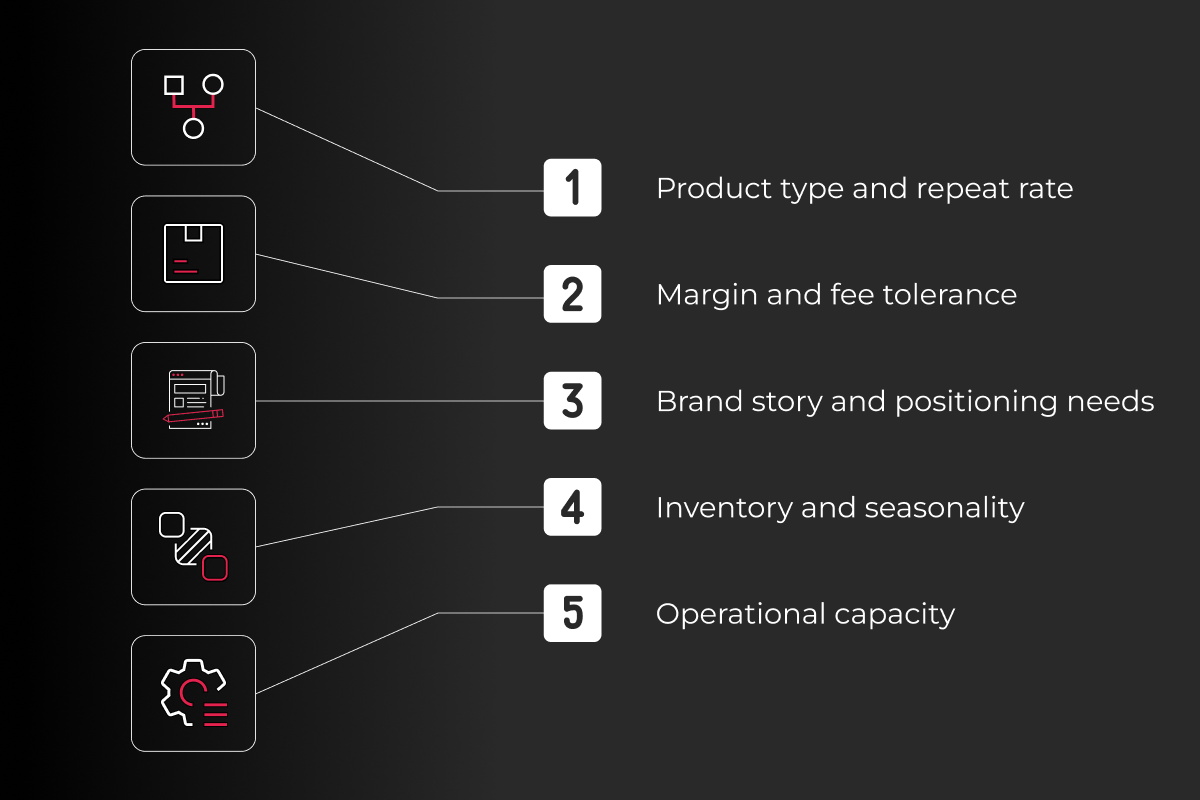
Use this as a quick filter before you commit budget or inventory.
1) Product type and repeat rate
- Great for Amazon: commodity-adjacent essentials, refills, broadly understood products, mid-ticket gear with clear specs.
- Great for DTC: premium products, strong differentiation, bundles, higher repeat potential, and products needing education.
2) Margin and fee tolerance
If your contribution margin is tight, Amazon can become unforgiving. DTC gives more flexibility, but only if your CAC and conversion rate are under control.
3) Brand story and positioning needs
If your edge is community, mission, or a distinct lifestyle identity, DTC is where that becomes tangible. Amazon can still support volume, but it’s rarely where a story fully lands.
4) Inventory and seasonality
Outdoor demand spikes are real. If you can’t reliably keep top SKUs in stock, Amazon velocity can become a liability. DTC can be easier to pace with controlled promotions and waitlists.
5) Operational capacity
Amazon requires listing excellence, review management, PPC structure, and compliance. DTC requires site merchandising, creative testing, email flows, and analytics. Pick the channel you can execute well, or build the capability.
The hybrid strategy most outdoor brands end up using
A lot of outdoor brands land on a blended approach because it reduces risk.
Here’s a clean model:
- Amazon = acquisition + velocity: capture high-intent demand, validate SKUs, and scale best sellers.
- DTC website = retention + margin expansion: bundles, product education, community, repeat purchase, and higher LTV.
A practical example: use Amazon to win “first purchase” on a hero SKU, then use DTC to deepen the relationship with accessories, bundles, and content that supports the customer’s next trip. That’s how you turn a one-time buyer into a repeat customer.
For seasonal planning, it also helps to align your content calendar with demand spikes. This pairs well with SEO-led strategy, like the approach outlined here.
FAQs: Amazon vs your own website for outdoor brands
Is Amazon cheaper than selling on my own website?
Not always. Amazon can reduce some operational burdens, but fees and ad costs can materially impact margins. Your website can be more profitable, but only if you manage CAC, conversion rate, and returns.
Should a small outdoor brand start on Amazon or DTC first?
If you have a limited audience reach and need faster demand, Amazon can help you get traction. If your differentiation depends on storytelling and premium positioning, starting on DTC can protect your brand and margins. Many brands launch both with a clear plan and a few hero SKUs.
Can selling on Amazon hurt my DTC business?
It can, if pricing, inventory, and messaging are inconsistent. It helps to decide which SKUs live where, maintain MAP/pricing discipline, and use DTC to offer bundles or exclusives that don’t directly compete with your Amazon offer.
What’s the fastest path to growth: Amazon PPC or driving traffic to my website?
Amazon PPC can convert quickly because shopper intent is high. Website traffic can scale fast too, but you need a strong offer, landing pages, and conversion-focused creative. The fastest path is usually the one you can execute and optimize consistently.
Do I need different creatives for Amazon vs my website?
Yes. Amazon creative should focus on clarity, proof, and comparison support (what it is, why it’s better, specs, use cases). DTC creative can go deeper on brand story, community, and lifestyle context.
The best channel is the one you can run profitably and improve weekly
Amazon and your own website aren’t enemies. They’re different tools. Amazon is built for demand capture. Your website is built for brand building and customer ownership. Outdoor brands that win treat both like parts of one system, with clear roles, clean measurement, and steady optimization.
If you want a plan that fits your category, margins, and goals, book a call with our team. We’ll help you map the right channel mix and execute with a performance mindset across the funnel.
Are you ready to grow?
At Algofy Outdoors, we partner with amazing outdoor brands to provide 360° digital marketing solutions.

.png)
.png)
.png)
