


The Outdoor Brand’s Guide to AI-Powered Product Content: Writing Descriptions That LLMs Actually Recommend
Outdoor brands are entering a new era of product discovery. Customers still search on Google and Amazon, sure, but they also ask AI tools what to buy. “Best ultralight tent for windy ridgelines?” “Warmest sleeping pad for winter camping?” These prompts are now part of the purchase path.
If your product content is vague, thin, or inconsistent, AI assistants struggle to interpret it, and your brand gets skipped.
Key takeaways
- AI-first product listings prioritize clarity, structure, and context so LLMs can extract the “why this is right” fast.
- Structured content wins: bullets, specs, comparisons, and FAQs improve AI extractability.
- Context beats keyword stuffing: include real use cases like winter camping, bikepacking, family trips, and glamping.
- Aim for semantic optimization that supports Amazon A9 plus AI shopping assistants.
- Conversion-focused content (reviews, objections, compatibility notes) increases the chance AI tools recommend your product.
How LLMs decide what to recommend (in plain terms)
LLMs do not “rank” products like Amazon A9 does. They summarize. They infer. They extract. Then they recommend based on signals they can confidently repeat.
That means your product description needs to answer questions an AI model is constantly trying to resolve:
- What is this product, exactly?
- Who is it for?
- What problem does it solve?
- What are the constraints (temperature rating, packed size, fit, capacity, compatibility)?
- What proof exists (materials, certifications, durability notes, warranty, real feedback themes)?
If your listing hides the essentials in fluffy paragraphs, the model can miss it. If your listing states the essentials clearly and consistently, the model can reuse it.
The anatomy of an AI-friendly outdoor product description
Think of your description like a field guide. It should be skimmable, specific, and ready to be quoted.
1) Start with a crisp “what it is” + “best for”
In the first 2 to 3 sentences, include:
- Product type and core differentiator
- Primary use case
- A concrete performance anchor (capacity, season rating, fabric, weight class)
Example shape (no hype, just clean):
“This 2-person backpacking tent is built for shoulder-season wind and fast setups. It packs down small, uses a ripstop fly, and balances ventilation with storm protection.”
2) Add use cases that sound like real trips
LLMs understand context better than isolated claims. Include 3 to 5 use scenarios:
- Cold-weather camping and condensation management
- Family campground setup speed
- Ultralight routes and pack volume constraints
- Wet climates, muddy trailheads, salt exposure near the coast
This is where “context > keywords” pays off.
3) Make specs impossible to miss
Structured content wins because models extract it easily.
Include a dedicated Specs at a glance section:
- Weight (trail weight and packed weight if applicable)
- Dimensions (packed and set-up)
- Materials (and why they matter)
- Temperature rating, R-value, denier, waterproof rating, battery life, lumen range
- What’s included in the box
- Compatibility notes (fits which stove canisters, pairs with which accessories, etc.)
4) Add comparisons and “fit guidance”
Many AI prompts are comparative by nature: “X vs Y.” Help the model help the buyer:
- “Choose this if…”
- “Skip this if…”
- “Size/fit notes…”
- “If you camp below 20°F, pair with…”
This also lifts conversion because it reduces returns and disappointment. Quietly, it saves ad spend too.
Writing for Amazon A9 and AI assistants at the same time
Amazon A9 still cares about relevance, conversion, and performance signals. AI shopping assistants care about clarity and confidence. The overlap is larger than people think.
Here’s a practical approach:
- Place critical attributes early (title, bullets, first paragraph)
- Reinforce with consistent terminology across bullets, A+ content, and FAQs
- Use synonyms naturally (sleeping pad, insulated pad, backpacking pad) so semantic coverage improves
- Keep claims tight and supportable. If it cannot be backed, remove it
If you’re working on broader Amazon growth, this is also where listing work connects to ads, SEO, and creative. Content is not separate from performance. It’s the foundation.
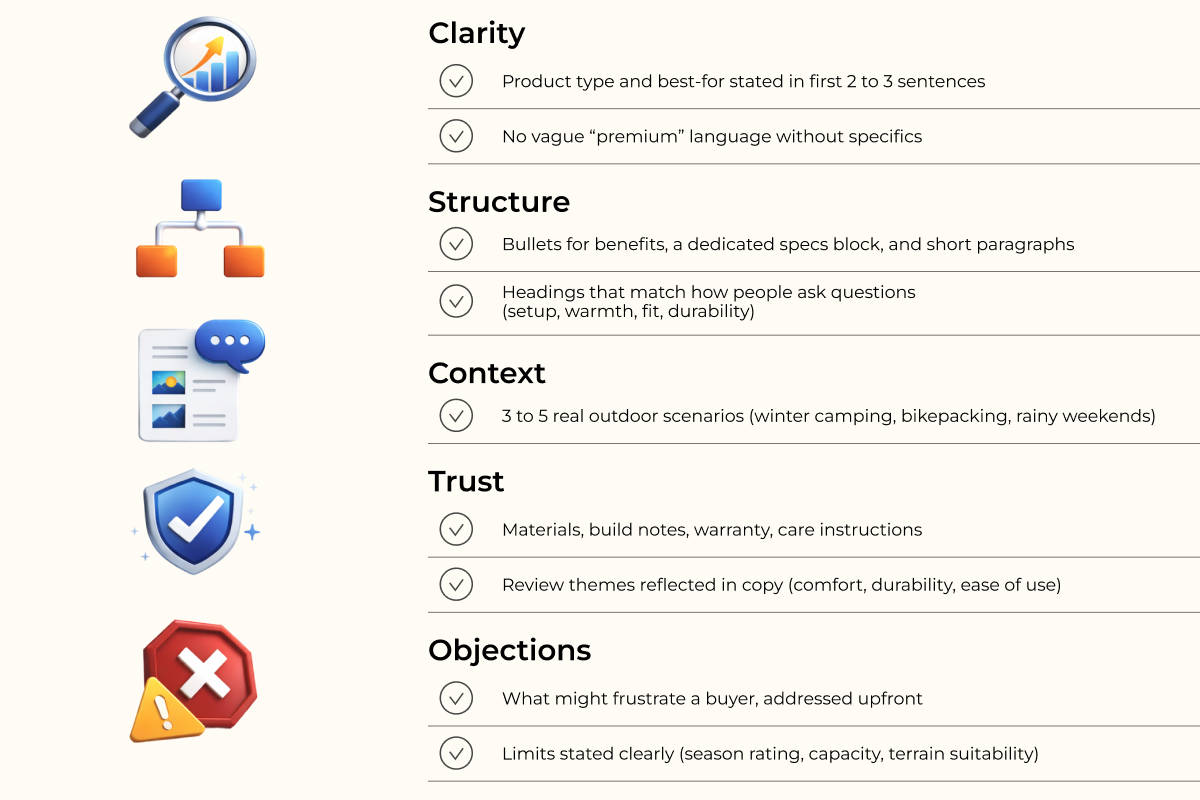
A repeatable framework: the “LLM-Ready Listing” checklist
Use this as a content QA pass before you publish:
One more small digression: if your internal team has a product FAQ in Slack or a customer support macro, that is gold. It’s basically a dataset of objections and language customers already use.
Frequently Asked Questions
What is AI-powered product content?
AI-powered product content is product copy designed to be easily interpreted and reused by AI systems, including shopping assistants. It uses clear structure, specific specs, and real use context so models can extract accurate recommendations.
How do I write product descriptions that LLMs recommend?
Lead with a precise product summary, include structured specs, add realistic use cases, and answer common objections. Use consistent language across your Amazon listing, A+ content, and FAQs so AI tools can confidently repeat the details.
Do bullets and specs really matter for AI search?
Yes. Bullets and specs improve extractability, making it easier for AI systems to identify key attributes like size, weight, materials, temperature rating, and compatibility.
How does this relate to Amazon Rufus and Amazon A9?
Amazon A9 rewards relevance and conversion. Rufus and other AI assistants prioritize clarity and confidence. Structured, consistent listings support both, improving discoverability and purchase readiness.
What’s the biggest mistake outdoor brands make with AI-first product listings?
Writing generic descriptions without context, specs, and fit guidance. When the copy lacks specifics, AI tools struggle to recommend it, and shoppers struggle to trust it.
Conclusion: make your content easy to quote
If an AI assistant cannot summarize your product accurately in a few lines, it’s a content problem. Fixing it is rarely about writing more. It’s about writing more clearly.
Start with the basics: define the product precisely, layer in real outdoor use cases, structure the specs so they stand out, and answer questions before the buyer asks them.
If you need help scaling AI-first product listings across Amazon and DTC, book a call with our team. And if you’re thinking about how content ties into seasonal search demand for outdoor gear, this is worth a read.
Are you ready to grow?
At Algofy Outdoors, we partner with amazing outdoor brands to provide 360° digital marketing solutions.



.png)
